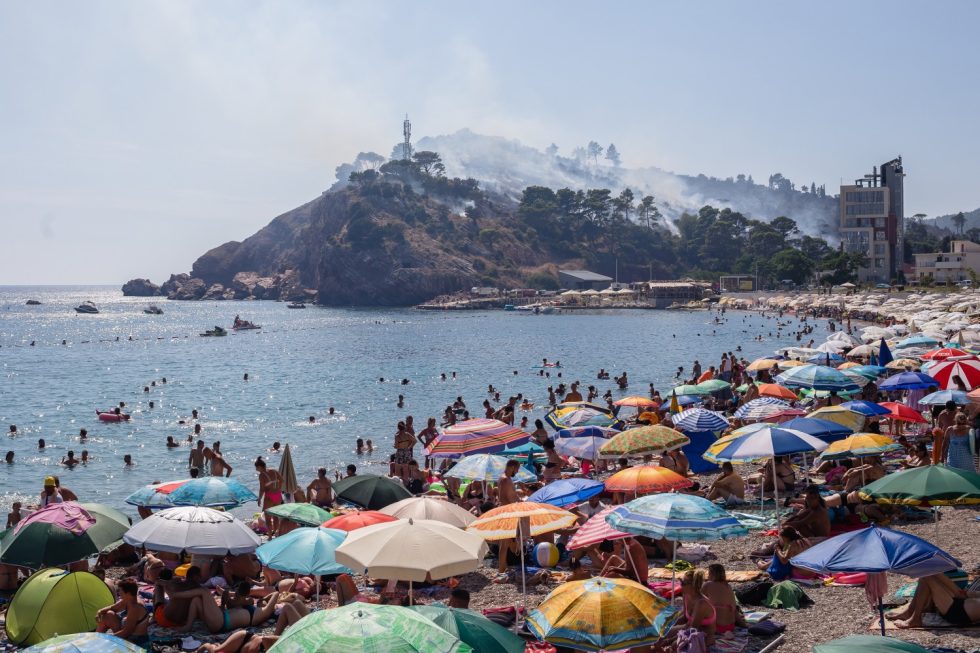
Meet Evgenij Yulkin, the third-prize winner of the regional photography exhibition “Landscape Fire Protection through the Camera Lens”. His award-winning photograph portrays a powerful contrast: people relaxing on a beach, seemingly unaware of the fire spreading across the hillside above them. Through this powerful scene, the photograph raises questions about human awareness, responsibility, and our relationship with nature.
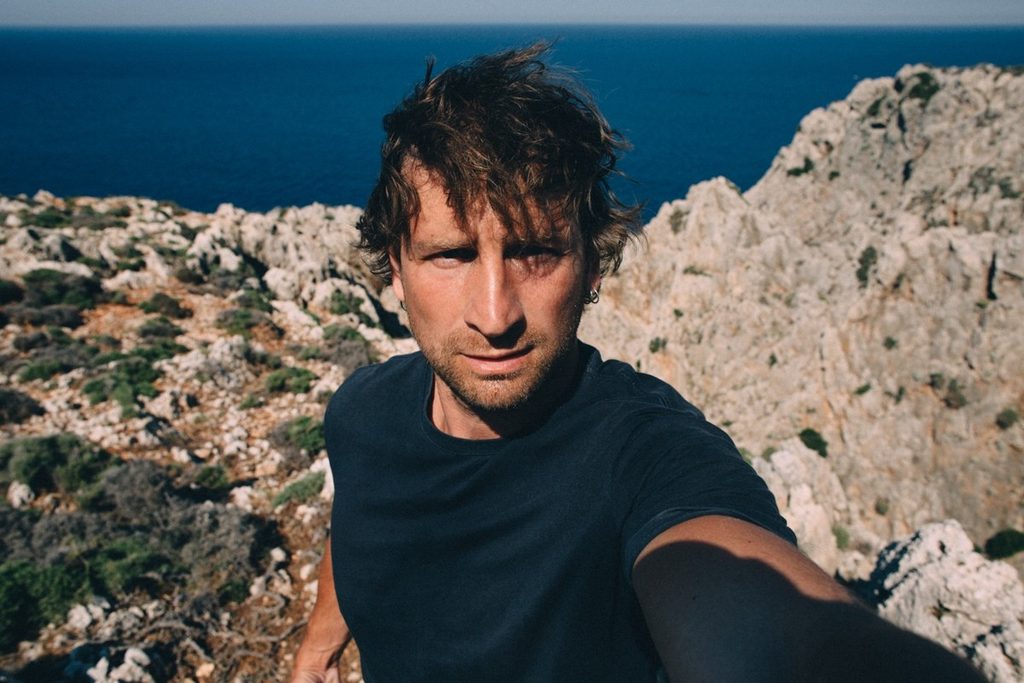
Evgenij is a storyteller and lifestyle photographer currently based in Montenegro. His work focuses on creating authentic photography and video content about families, real people, and fictional stories. For the past 12 years, he has been conducting photography workshops across Russia and Europe, and for 5 years he has been running his own online photography school. Through his educational work, he helps photographers develop their storytelling skills and learn how to create meaningful visual narratives by applying the principles of dramaturgy.
He regularly participates as a speaker at photography festivals and is a jury member of the Russian Photo Award, one of the largest photography competitions in Russia. For more than 10 years, she has also been a contributor to Stocksy United, one of the world’s leading stock photography agencies.
- Every photograph tells a story. What is the story behind your photograph, and what inspired you to capture this moment?
It was my second year living in Montenegro. The summer of 2024 was very hot, and for the first time in my life I encountered such catastrophic fires. When my family and I first arrived in the country, we lived in a house at the foot of Golobrdo in Sutomore and loved walking along the mountain above the sea. It’s a truly stunningly beautiful place!
Later we moved to live in the city of Bar, located 9 kilometers from Sutomore. I learned about the fire on Golobrdo from the news only in themorning after the night fire. By that time, the intense fire had died down, and the remains of vegetation and trees were smoldering and smoking across the entire mountain. I wanted to capture the aftermath of the fire, so I went to Sutomore. I climbed Golobrdo and walked along the entire mountain to the central beach. It was very risky because the acrid smoke made breathing very difficult. Looking down on the crowds of carefree beachgoers, I was struck by the strange contrast between what was happening here and there. I wondered how all these people were viewing the disaster. Then I found myself on the beach and took this photo.
- What cannot be seen in the photograph but is something you personally carry with you from that moment?
In my opinion, this photograph is incredibly simple and understandable to any viewer. This image demonstrates how indifferent society is to the fires. But on the other hand, how can beachgoers make a difference? This photograph is simply a statement of fact. A feast during the plague. People continue to enjoy life as long as they can, despite the cataclysms that happen around them, and they cannot be blamed for this.
- What is your personal connection with nature and landscapes?
I’ve always loved nature since childhood and spent a lot of time walking in forests and fields. I also worked with farm animals as a teenager. Therefore, nature is of great importance to me; it’s a part of me, a part of my essence.
- Your photograph portrays a part of the Western Balkan landscapes. How do you see the relationship between people and nature today, and how do you reflect on the changes our landscapes have experienced in recent years, including pollution, landscape fires, and other challenges?
When I arrived in Montenegro, I was shocked by the amount of trash everywhere. I have never seen anything like this anywhere. The first thing I saw was the enormous amount of household garbage in the canals and fields along the Spičansko Polje near Mount Golobrdo. I never imagined people could pollute nature and their communities so much. I was also shocked by the indifference of some people to garbage. Later, I myself repeatedly witnessed people throwing bags of garbage into canals, hauling it away in trucks, and dumping it along lonely mountain roads. A community of Russian-speaking expats formed in Montenegro, and we gathered every weekend to collect and remove trash. We cleaned canals, fields, forests, and the coastline in Sutomore. Now, my family and I periodically join in the environmental cleanups organized by the volunteer organization Nisam Turista. This is a community of people who put out fires and clean up trash. There’s one more thing I can’t control: wastewater in the sea. This problem is especially acute during the peak season. The sewer system simply can’t cope. And in some homes and private households, the wastewater simply flows into the nearest ditch.
- Landscape fires can leave lasting scars on nature and communities. In your opinion, how can photography help raise awareness and inspire people to better protect our landscapes?
I don’t think photographs, stories or films can fundamentally change people’s attitudes toward forest fires and environmental protection. No one realizes how important it is to protect nature until, for example, they themselves lose their favorite piece of nature in a fire, the place where they grew up or their children grew up. Until fire literally destroys part of their life.
- Protecting landscapes is shaped by the choices and actions of individuals and communities. What is your personal contribution to preserving nature and the environment?
In addition to my participation in cleaning campaigns, we try to maintain the cleanliness of the place where we live and the surrounding environment at a household level. In addition to my participation in cleanup campaigns, we strive to maintain cleanliness in our neighborhoods and the surrounding environment at the household level. Sometimes, we report pollution issues in a particular area to the municipal authorities if we encounter any.
- If your photograph could leave one message for future generations, what would you want that message to be?
In many ways, the perception of a photograph depends on the viewer, their cultural level, life experience, and social conditions. This must be considered. However, I’ve always noticed that people express regret when they learn, including through photographs from the past, of the loss of natural beauty. Ten years ago, Mount Golobrdo was completely covered in forest, but now only a few dozen trees remain. It’s precisely these kinds of changes that should impact people’s consciousness. If there was once a place where there was wonderful nature, and now it’s gone, we need to show people this so they can consider why this happened and what conditions they live in now. I’m referring to the deterioration of the environment due to the loss of natural resources through fires or pollution.
- Having photographed landscapes in different places, what makes the Western Balkans unique, and what do you think people here sometimes overlook about their own natural heritage?
The Western Balkans’ sharp climatic gradients, ranging from Mediterranean coastal microclimates to subalpine conditions within short geographical distances, have enabled the survival of ancient flora and fauna. As a result, the region boasts a remarkably high level of endemism and, overall, an incredibly rich and diverse natural environment.
When people grow up surrounded by extraordinary landscapes and wild unspoiled nature is simply the baseline everywhere. In the Western Balkans, locals often take for granted ecological features that have become nearly extinct across the rest of the European continent. The greatest oversight is treating this nature richness as permanent background scenery rather than a fragile, world-class ecological heritage under increasing pressure from rapid industrial development.